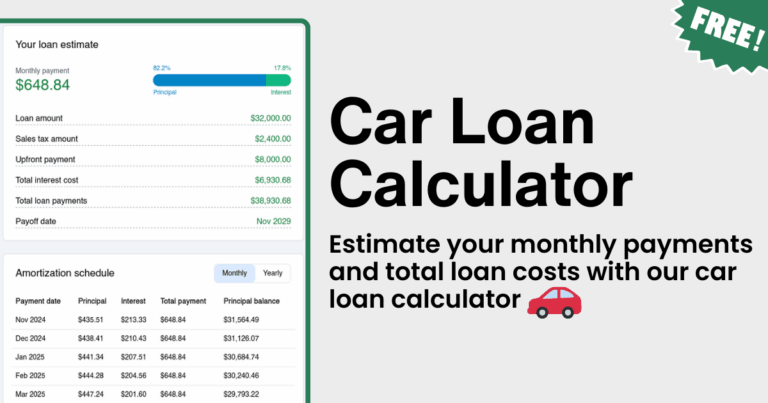
Unlock Financial Clarity: Your Ultimate Car Loan Calculator Guide for Google Sheets
Unlock Financial Clarity: Your Ultimate Car Loan Calculator Guide for Google Sheets Carloan.Guidemechanic.com
Buying a car is an exciting milestone, but the financial aspects can often feel like navigating a complex maze. From understanding interest rates to deciphering monthly payments, the jargon alone can be overwhelming. Many prospective car owners find themselves relying solely on dealership figures or generic online calculators, which, while helpful, rarely offer the granular insight needed for truly informed decisions.
What if you could take control of your car loan calculations, tailor them to your specific needs, and gain a profound understanding of every penny you’ll pay? This is precisely where a custom Car Loan Calculator Google Sheets becomes an invaluable tool. It’s more than just a numbers game; it’s about empowering you with financial foresight and ensuring you make the smartest possible choices for your budget.
Unlock Financial Clarity: Your Ultimate Car Loan Calculator Guide for Google Sheets
In this comprehensive guide, we’ll dive deep into creating your very own powerful and flexible car loan calculator using Google Sheets. We’ll cover everything from the fundamental inputs to advanced customizations, ensuring you not only build the tool but also understand the financial principles behind it. By the end, you’ll have a pillar of personal finance at your fingertips, ready to demystify any auto loan offer.
Why a Custom Car Loan Calculator in Google Sheets is Your Financial Superpower
When considering a car loan, most people turn to quick online calculators. While these tools provide an instant estimate, they often lack the flexibility and detail required for thorough financial planning. They’re great for a snapshot, but they don’t let you play with different scenarios or visualize the true cost over time.
Based on my experience as a financial content creator and planner, relying solely on generic online calculators often leaves significant gaps in understanding. You don’t see the full amortization schedule, you can’t easily factor in extra payments, and you certainly can’t customize it to include specific local taxes or fees. This lack of transparency can lead to unexpected costs or missed opportunities for savings.
A DIY Google Sheets car loan calculator puts you firmly in the driver’s seat. It offers unparalleled flexibility, allowing you to adjust variables like interest rates, loan terms, and down payments instantly. This level of control not only helps you understand your current situation but also empowers you to negotiate better deals and plan for future financial freedom. It transforms a passive calculation into an active, insightful financial exercise.
Essential Components of Any Car Loan Calculation
Before we dive into the spreadsheet, it’s crucial to understand the core elements that dictate your car loan. These are the fundamental inputs your auto loan amortization schedule will be built upon. Getting these right is the first step towards an accurate calculation.
First, consider the Loan Amount (Principal). This is the actual amount of money you need to borrow after any down payment, trade-in value, and factoring in sales tax and other fees. It’s not just the car’s sticker price, but the total sum the bank is lending you. Understanding this distinction is vital for an accurate calculation.
Next, the Interest Rate (APR) is perhaps the most significant factor affecting your total cost. APR stands for Annual Percentage Rate, representing the yearly cost of borrowing money, including some fees. A small difference in APR can translate into thousands of dollars saved or spent over the life of the loan. Always ensure you’re using the annual rate as quoted by lenders.
Then there’s the Loan Term, which is the duration over which you agree to repay the loan, typically expressed in months or years. Common terms range from 36 to 72 months, or even longer. While a longer term might offer lower monthly payments, it almost always results in paying more interest over time. Conversely, shorter terms mean higher monthly payments but less total interest.
Finally, don’t forget the impact of a Down Payment and Trade-in Value. A substantial down payment reduces the principal loan amount, thereby lowering your monthly payments and the total interest paid. Similarly, if you’re trading in your old vehicle, its value directly reduces the amount you need to finance. These elements significantly influence the overall affordability and long-term cost of your new car.
Setting Up Your Google Sheets Workspace
Getting started with your personal finance spreadsheet in Google Sheets is straightforward. A clean, well-organized workspace is key to making your calculator easy to use and understand. This initial setup will save you time and confusion later on.
Begin by opening a new blank spreadsheet in Google Sheets. Give it a clear and descriptive title, such as "My Car Loan Calculator" or "Auto Loan Amortization Tracker." A good title helps you easily find your document later and clarifies its purpose.
Next, dedicate specific cells for your input variables. It’s best practice to label these clearly in adjacent cells. For instance, you might use cell A1 for "Loan Amount:", B1 for the actual amount, A2 for "Annual Interest Rate:", B2 for the rate, and so on. This creates a user-friendly interface for anyone using your calculator, including yourself in the future.
Finally, apply basic formatting to enhance readability. Use bold text for labels, currency formatting for monetary values, and percentage formatting for interest rates. This makes your spreadsheet look professional and ensures you’re inputting numbers in the correct format, preventing calculation errors. A well-formatted sheet is far less prone to mistakes and much easier to interpret at a glance.
Step-by-Step Guide: Building Your Car Loan Calculator
Now for the exciting part – bringing your DIY car loan calculator to life! We’ll walk through each essential calculation, building a robust tool that provides deep financial insights. This section will focus on the practical application of formulas within Google Sheets.
A. Inputting Your Core Loan Data
The foundation of your calculator lies in accurately inputting your loan details. Dedicate specific cells for each variable we discussed earlier. Let’s assume the following layout for our example:
- B1: Loan Amount (e.g., $25,000)
- B2: Annual Interest Rate (e.g., 5.5% or 0.055)
- B3: Loan Term in Years (e.g., 5)
- B4: Down Payment (e.g., $5,000)
- B5: Trade-in Value (e.g., $3,000)
- B6: Sales Tax Rate (e.g., 7% or 0.07)
- B7: Other Fees (e.g., $500)
Now, let’s calculate the Actual Loan Principal you’ll be financing. This is crucial because it’s not just the car’s price. In cell B8, you could input: =B1 - B4 - B5 + (B1 * B6) + B7. This formula takes your car’s base price, subtracts down payment and trade-in, and then adds sales tax and other fees to determine the true amount you need to borrow. Make sure B8 is formatted as currency.
B. Calculating Your Monthly Payment (PMT Function)
The monthly payment is the figure most people focus on, and Google Sheets has a powerful function specifically for this: PMT. This function calculates the payment for a loan based on constant payments and a constant interest rate. It’s the heart of your calculate car payments tool.
The PMT function syntax is =PMT(rate, nper, pv, , ). Let’s break down the arguments:
rate: This is the interest rate per period. Since your loan term is usually in years and interest rate is annual, you must convert the annual rate to a monthly rate. If your annual rate is in B2 and the term is monthly, useB2/12.nper: This is the total number of payment periods. If your loan term in years is in B3, you’ll multiply it by 12 for monthly payments:B3*12.pv: This is the present value, or the total amount that a series of future payments is worth now. For a loan, this is your actual loan principal (from cell B8). Input this as a negative number because it represents money you receive.
So, in cell B9, you would enter the formula: =PMT(B2/12, B3*12, -B8).
Pro tips from us: Remember to always convert your annual interest rate to a monthly rate by dividing it by 12. Similarly, convert your loan term from years to months by multiplying by 12. Forgetting these conversions is a common mistake that leads to inaccurate monthly payment calculations. Also, inputting the present value (principal) as a negative number will result in a positive monthly payment, which is easier to read.
C. Crafting the Amortization Schedule
This is where your amortization table Google Sheets truly shines. An amortization schedule details every single payment you make, breaking down how much goes towards interest and how much towards the principal. It’s vital for understanding how your debt reduces over time and for visualizing the true cost of your loan. From my perspective as a financial planner, the amortization schedule is the true powerhouse of this tool, offering unparalleled transparency.
Set up the following columns, starting from, say, A12:
- Payment Number (A): Simply number each payment period sequentially (1, 2, 3, … up to your total loan term in months). You can enter 1 in A12, 2 in A13, then select both and drag down to fill the series.
- Starting Balance (B): For the first payment (A12), this will be your actual loan principal (from B8). For subsequent payments, it will be the "Ending Balance" from the previous row.
- Interest Paid (C): Use the
IPMTfunction:=IPMT(rate, per, nper, pv).rate: Monthly interest rate (B2/12).per: The current payment period (e.g., A12).nper: Total number of payments (B3*12).pv: Actual loan principal (-B8).- Example for C12:
=IPMT($B$2/12, A12, $B$3*12, -$B$8)(Use dollar signs for absolute references to lock the rate, nper, and pv cells when dragging down).
- Principal Paid (D): Use the
PPMTfunction:=PPMT(rate, per, nper, pv). The arguments are identical toIPMT.- Example for D12:
=PPMT($B$2/12, A12, $B$3*12, -$B$8)
- Example for D12:
- Ending Balance (E): This is the starting balance minus the principal paid for that period.
- Example for E12:
=B12 - D12 - For E13, the starting balance (B13) would be
=E12. Then drag E13 down.
- Example for E12:
Once you have the formulas for the first row (A12-E12), carefully drag them down for all payment periods. You’ll see how the interest portion decreases with each payment, while the principal portion increases. The ending balance should ideally reach $0 (or very close to it) after the final payment. This detailed breakdown is crucial for understanding how to calculate car payments and track debt reduction.
D. Summarizing Key Financial Metrics
Beyond the monthly payment and amortization, it’s incredibly useful to have a summary of the overall financial impact of your loan. This helps you quickly grasp the true cost.
- Total Interest Paid: In a cell (e.g., B10), use
=SUM(C12:C). This will give you the sum of all interest payments. - Total Cost of Loan: In another cell (e.g., B11), this is simply your actual loan principal plus the total interest paid:
=B8 + B10. This figure represents the total money you will have paid for the loan itself, excluding the down payment or trade-in value.
Don’t forget to account for any upfront fees or down payments when considering your true total cost of ownership. While the calculator focuses on the loan, these broader figures give a complete picture. This summary offers quick insights into your loan principal and interest breakdown.
Advanced Customizations and Features
Your Car Loan Calculator Google Sheets is already powerful, but we can enhance it even further. These advanced features will transform it into an indispensable financial planning tool, allowing for deeper analysis and scenario planning.
Scenario Planning (What-If Analysis)
One of the most powerful aspects of Google Sheets is its ability to perform "what-if" scenarios. Based on my experience, this is where you truly gain an edge over standard online calculators. You can instantly see the impact of changing variables like the interest rate, loan term, or down payment.
To facilitate this, consider adding input fields for alternative scenarios. For example, you could duplicate your core input section and title it "Scenario 2." This allows you to compare two different loan offers side-by-side, or see how a larger down payment impacts your monthly payment and total interest. You might even use Google Sheets’ Data Validation feature to create dropdown menus for common loan terms (e.g., 36, 48, 60, 72 months), making it even easier to switch between options. This helps in understanding how to save money car loan by adjusting different parameters.
Modeling Extra Payments/Early Payoff
Many people want to pay off their car loan faster to save on interest. Your Google Sheets calculator can model this with ease. Add an extra column to your amortization schedule, perhaps labeled "Extra Payment." In this column, you can input an additional amount you wish to pay each month.
Then, adjust your "Ending Balance" formula. Instead of Ending Balance = Starting Balance - Principal Paid, it would become Ending Balance = Starting Balance - Principal Paid - Extra Payment. This allows you to see how quickly your loan balance reduces and how much total interest you save. Pro tip: You’ll also need to adjust your PMT, IPMT, and PPMT formulas to account for the actual payment made (monthly payment + extra payment) rather than just the calculated monthly payment. This helps visualize the benefits of early car loan payoff.
Visualization with Charts
Numbers are informative, but charts tell a story. Google Sheets offers robust charting capabilities that can bring your amortization schedule to life. Create charts to visualize:
- Interest vs. Principal Paid Over Time: A stacked column chart or area chart showing how the proportion of interest versus principal changes with each payment. You’ll typically see a larger portion going to interest at the beginning of the loan.
- Loan Balance Reduction: A line chart tracking your "Ending Balance" over the loan term. This visually demonstrates the steady decline of your debt.
These visualizations provide an intuitive understanding of your financial commitment and the progress you’re making towards ownership.
Integrating Sales Tax & Fees More Dynamically
While we included sales tax and fees in our initial principal calculation, you can make this more dynamic. Create separate input cells for various fees (e.g., "Documentation Fee," "License & Registration," "Dealer Prep Fee"). Then, your "Actual Loan Principal" formula can sum these directly, allowing you to easily adjust or add new fees as they come up during the car buying process. This ensures your financial planning car purchase is as accurate as possible.
Conditional Formatting for Alerts
Conditional formatting can highlight important information or potential issues. For instance, you could:
- Highlight cells if the "Ending Balance" isn’t exactly zero at the end of the loan term (indicating a formula error).
- Color-code payments where an "Extra Payment" was made.
- Highlight the total interest paid if it exceeds a certain percentage of the principal, prompting a review of the interest rate or loan term.
These visual cues make your spreadsheet even more intelligent and user-friendly.
Common Mistakes to Avoid When Using Your Car Loan Calculator
Even with a perfectly built spreadsheet, there are common pitfalls that can lead to misinterpretations or inaccurate planning. Based on my experience, I’ve seen these mistakes crop up repeatedly. Being aware of them will help you leverage your Google Sheets car loan calculator to its full potential.
Firstly, a very frequent error is forgetting to convert annual rates to monthly rates. The PMT, IPMT, and PPMT functions all require the interest rate per period. If your loan term is monthly (which it almost always is), you must divide the annual interest rate by 12. Using the annual rate directly will drastically overstate your monthly payments and total interest, leading to significant confusion.
Secondly, many people ignore additional costs beyond the car’s sticker price. This includes sales tax, registration fees, documentation fees, and sometimes even extended warranty costs rolled into the loan. These can significantly inflate your actual loan principal. Your calculator must account for these to provide an accurate reflection of the amount you truly need to borrow. Failing to do so can lead to unexpected out-of-pocket expenses or a higher loan than anticipated.
Thirdly, not reviewing the amortization schedule thoroughly is a missed opportunity. While the monthly payment is important, the amortization schedule reveals how much interest you’re paying early on versus later in the loan. It helps you understand the impact of extra payments. Simply glancing at the total interest paid without understanding its distribution over time means you’re not fully utilizing the power of your loan repayment tracker.
Finally, assuming the first loan offer is the best without comparing it is a common financial misstep. Your Google Sheets calculator is an excellent tool for comparing multiple loan offers from different lenders. Input each offer’s terms (rate, term, principal) into separate sections or different sheets within your workbook. This allows for an objective, side-by-side comparison, ensuring you secure the most favorable terms available. Always shop around!
Maximizing Your Car Loan Calculator for Financial Wisdom
Your custom Car Loan Calculator Google Sheets is far more than just a simple calculation tool; it’s a strategic asset for your financial well-being. By understanding its capabilities, you can unlock a deeper level of financial wisdom and make truly informed decisions.
Firstly, use it as a powerful negotiation tool. When you walk into a dealership armed with a clear understanding of your potential monthly payments across various scenarios, you gain significant leverage. You can confidently counter offers or understand if a seemingly "good deal" on a monthly payment actually hides a longer term or higher interest rate. This puts you in control of the conversation, rather than just reacting to the numbers presented to you.
Secondly, integrate your calculator into your broader budgeting aid. Your car payment is a significant monthly expense. By knowing exactly what that payment will be and how it breaks down into principal and interest, you can accurately allocate funds in your budget. This foresight helps prevent financial strain and ensures your car ownership fits comfortably within your overall financial plan. Consider linking this payment directly to your main budgeting spreadsheet (if you have one) for seamless financial oversight. For more tips on managing your budget effectively, check out our guide on .
Thirdly, leverage it for proactive debt management strategy. The amortization schedule clearly shows how much interest you’re paying over the life of the loan. This insight can motivate you to make extra payments, even small ones, to reduce the principal faster and save a substantial amount on interest. Seeing the tangible impact of an extra $50 or $100 per month can be a powerful motivator for accelerating your debt payoff. It empowers you to take control of your car finance calculator and its outcomes.
Finally, the process of building and using this calculator significantly enhances your financial literacy. You learn about interest compounding, amortization, and the true cost of borrowing. This hands-on experience demystifies complex financial concepts, equipping you with knowledge that extends beyond car loans to other forms of debt and investments. This foundational understanding is invaluable for lifelong financial health. If you’re still weighing whether to buy new or used, our article on might help you further refine your loan needs. For a deeper dive into understanding loan terms and APR, you can refer to trusted sources like the Consumer Financial Protection Bureau (CFPB) website.
Conclusion: Drive Your Financial Future with Confidence
Building your own Car Loan Calculator Google Sheets is an investment in your financial future. It transforms a potentially confusing and costly process into an empowering journey of understanding and control. No longer will you be guessing about interest costs or wondering about the impact of a different loan term. Instead, you’ll have a unique, custom-built tool that provides transparent, accurate, and actionable insights.
This pillar content guide has walked you through every step, from setting up your spreadsheet to advanced customizations and common pitfalls to avoid. You now possess the knowledge and the framework to create a powerful auto loan amortization schedule that serves your specific needs. It’s about more than just numbers; it’s about gaining clarity, making smarter financial decisions, and ultimately, driving away with confidence, knowing you’ve secured the best possible car loan for your situation.
So, open Google Sheets, follow these steps, and start building your financial future today. Take control of your car loan and unlock the path to greater financial wisdom.